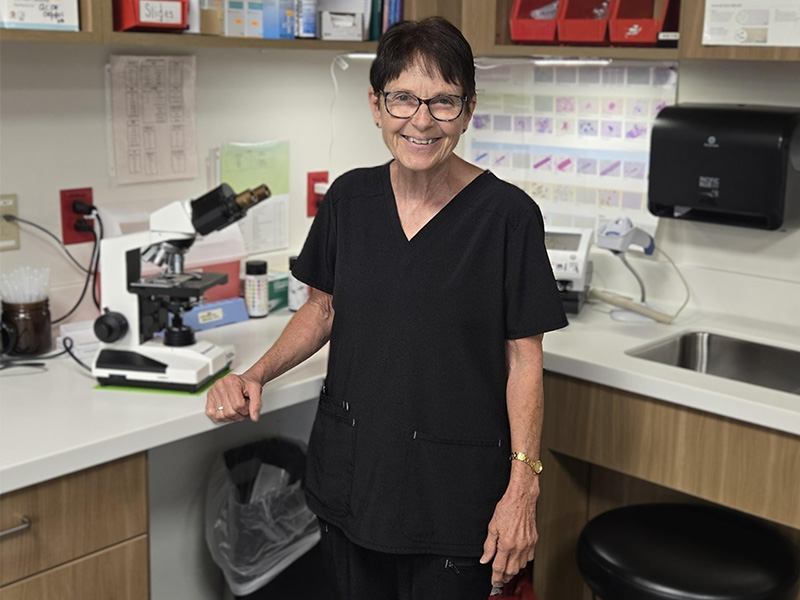
KNOXVILLE, IA – On September 7, 1971, Barb Anderson began her career at Collins Hospital, now Knoxville Hospital & Clinics. She never imagined that more than five decades later, she would still be involved in health care at the same facility that gave her the start.
A Knoxville native, Barb, says staying in Knoxville and working at the local hospital was always her goal. While still in high school, at the suggestion of her guidance counselor, Mr. Jim Bell, she job-shadowed at the Knoxville Veterans Hospital Laboratory. Bell would later help her find a laboratory program at DMACC, where she received a tuition grant to pursue her studies.
Just three days after graduating from the DMACC Laboratory Program, Barb began her first day in the Laboratory Department as a Lab Assistant. She went on to earn her Medical Technologist degree, and in the late 80s, became the Laboratory Manager – a position she held until her transition from full-time to PRN in 2018.
“I recall Dr. Dwight Mater and Helen Roberts, the hospital administrator at the time, interviewing me. To work in Knoxville with my people, my family, and my community was the best thing that could happen,” said Barb.
From Manual Testing to Robotic Technology
When Barb began working in the Laboratory in 1971, testing was a very different process. Blood was manually added to a pipette with a diluting fluid and mixed. The sample was then viewed under a microscope, where technicians counted blood cells in a grid and calculated the number per cubic centimeter to provide results to the physician.
Today, technology has transformed the Laboratory.
The current Laboratory features state-of-the-art, robotic, temperature-controlled, interfaced, bar-coded and computerized equipment, allowing testing to be performed with a level of speed, precision and efficiency that was unimaginable when Barb began her career.
Watching KHC Grow
As the longest-tenured employee at Knoxville Hospital & Clinics, Barb has witnessed countless changes to the facility and organization over the past 55 years. One of the milestones she remembers most clearly was moving from Collins Hospital to the newly built Knoxville Area Community Hospital in 1981.
“The amount of space we had in the new Lab was amazing compared to what we had at the old hospital,” recalls Barb. “I remember moving equipment, glassware, instruments, and blood bank records in my car. After getting everything set up, the next day we began seeing patients.”
Even though the new space seemed enormous in 1981, Barb says the current Laboratory is approximately six times the size of that original Lab.
“There is so much more room in our current Lab where there are dedicated areas to each specialty so the staff who operate those machines and run the tests are more focused on their task.”
A Changing Health Care Landscape
Barb has witnessed not only changes in Laboratory technology, but also the many ways health care and Knoxville Hospital & Clinics have evolved over the years.
“We have had a lot of changes in 50-plus years, but one of the biggest changes in the Laboratory was the electronic medical record process,” remembers Barb.
In the past, Laboratory results were manually recorded and added to patients’ paper medical records. Barb remembers that different colored ink was even used to identify when a chart had been updated – black ink for the day shift, blue ink for second shift and red ink for third shift.
Clinic and outpatient records were hand-delivered to providers to be added to their paper charts. Today, Laboratory results are transmitted electronically and are available to providers and specialists almost immediately.
The growth of services and the addition of specialty providers over the years, Barb says, have further enhanced the patient experience at Knoxville Hospital & Clinics.
“It has been rewarding to see how new services, equipment, and providers have allowed patients to receive care close to home – eliminating having to travel for their care,” said Barb. “I am proud that our administration and staff continue to stay on top of the latest medical techniques.”
A Career Well Spent
When reflecting on 55 years in health care, Barb encourages those just beginning their careers to find an area of medicine that interests them and embrace every opportunity to learn.
“There is definitely a need for people in health care. Find an area that fits your needs and interests and soak it up. Keep getting educated and receive the training because it will serve you well throughout your career,” shared Barb.
Barb retired from full-time employment in May 2018 but continues to stay connected to Knoxville Hospital & Clinics, working in the Laboratory as needed.
Outside of the hospital, Barb stays busy volunteering with her church, the DAR, Helping Hands and the Lutheran Mission Quilting Group. She also provides her granddaughter with daily rides to school. And this year, she took her first cruise – to Italy – which she thoroughly enjoyed.
After 55 years, Barb says she can’t help but feel a deep sense of pride when she reflects on her career and the organization she has watched grow.
“My time at Knoxville Hospital & Clinics has been incredibly rewarding. I’ve had the opportunity to learn, grow, and truly enjoy the work I do in an organization that continues to grow and move forward. I credit our administration for creating an environment that supports that success. It has always been an honor to be part of Knoxville Hospital & Clinics.”
Knoxville Hospital & Clinics is a non-profit community hospital serving Marion County and the surrounding area. Named a 2025 Top Workplaces Industry winner, KHC’s highly skilled staff and specialists are committed to providing personal, compassionate, and innovative health care to individuals in our area. For more information regarding this release and other happenings at Knoxville Hospital & Clinics, call the Public Relations Department at (641) 842-1418 or visit knoxvillehospital.org.